
When a storm washes out your road, getting food, water or medical supplies can suddenly become much more complicated.
A Houston-area company believes part of the answer could come from above.
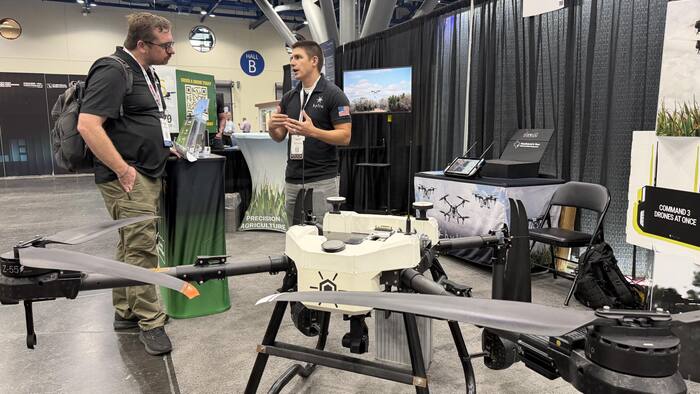
At the Texas Disasters Expo in Houston, Richmond-based Hylio displayed a large agricultural drone that the company says could carry critical supplies over flooded roads and other obstacles to people emergency crews cannot easily reach.
For Keith Edwards, Hylio’s head of business development, the possibility is personal.
“Being from Houston, I’ve lived through multiple hurricanes and tropical storms,” Edwards said.
Working with agencies he grew up knowing, he said, would be “really special to me.”
“Doing something that could help someone in need is is is really cool,” he said.
Hylio primarily manufactures agricultural drones, with customers including farmers and businesses that apply agricultural products. But Edwards said the machines’ durability has drawn interest from people looking for new ways to deliver emergency supplies.
“When you build a drone that can spray for 8 to 10 hours a day in the heat of summer with corrosive chemicals, it’s also a very durable machine that can be used in a lot of other cases,” Edwards said.
The drone displayed at the expo could carry about 90 pounds in its current configuration, according to Edwards. With that load, he estimated a flight time of 20 to 25 minutes.
An operator could launch it from an accessible location, fly supplies over obstacles and deliver them using a dropping mechanism, he said. The drone could then return for another load and a battery swap.
That possibility addresses a problem KPRC 2 has reported on in Indian Springs: An oxygen delivery driver got stuck trying to reach someone because of road conditions.
Asked how a drone could help in a situation like that, Edwards described repeated supply runs.
“So we could just drop those supplies down, come back, resupply, swap batteries and deliver more critical emergency supplies,” he said.
The potential use is still developing. Edwards said Hylio’s customers have not yet implemented disaster deliveries, although some utility customers already use its drones to move items into hard-to-reach areas.
The company is exploring relationships with government agencies and other potential customers. Edwards said Hylio generally sells the equipment rather than operating a delivery service itself.
In Pasadena, drones are already helping emergency managers understand what a storm leaves behind.
Azell Carter, the city’s emergency management coordinator, said crews use smaller drones to survey damage and send live video to the emergency operations center.
That footage, combined with digital mapping, helps officials identify blocked roads, assess debris and determine where to send personnel.
It is a significant change from Hurricane Harvey in 2017, when Carter said they used paper forms and maps.
During Hurricane Beryl, Pasadena used drones to survey debris and digital tools to collect damage assessments, he said. Residents who were not home could use a QR code to submit information and receive follow-up contact.
For Carter, that technology has value beyond saving staff time. It can also reassure people trying to recover.
Seeing information submitted digitally, he said, gives survivors comfort: “Hey, my information has been sent, help should be coming at some point.”
Pasadena also uses artificial intelligence to help staff think through emergency scenarios, develop public messaging and work on plans and manuals, Carter said.
Staff review and fact-check the results.
The goal is to help emergency managers work through information faster and communicate in ways people can understand.
“It can help us be able to answer questions in a manner that can actually reach the people in the way that they want to be spoken to,” Carter said.
Edwards said Hylio also incorporates AI into its technology. Its smaller Photon drone has onboard computing capabilities that he said can support identification and tracking tasks, with potential applications in search and rescue.
Looking ahead five to 10 years, Edwards expects more connected systems that can share information more effectively. He also said coordination matters as more aircraft and technology enter emergency response operations.
Carter expects disaster response to become more automated, including applications, damage reporting and debris tracking.
Funding and training remain barriers to putting more of these tools to work, Carter said. Hylio said a drone like the one displayed costs about $45,000.
“Funding definitely is the hardest thing,” Carter said. “I would love to buy a lot of this stuff in here personally. But, you know, there’s a process, right?”
The investment also requires trained personnel who can put the equipment to use.
“There’s no need of buying something that you don’t have the expertise or individual to actually operate it, because at that point now it becomes wasted, a wasted piece of technology which could be used if you had the proper training to it,” Carter said.
And even as the tools improve, human judgment remains essential.
“The human component is still necessary,” Carter said. “I think if we can merge the excellence of the automation with the just the ingenuity of the human, we can have a very good product and disaster response in the future should be significantly better.”
He sees the promise in combining technology with the people whose job is to help their neighbors.
“We’re going to embrace that change because it’s going to help us do our job significantly better and help us do what we want to do, and that’s help people,” he said.
His reminder for residents: Better technology does not eliminate the need to prepare.
Keep important documents protected, have cash available, charge your phone and fuel your vehicle before an event if you may need to evacuate, Carter said.
“Technology can’t replace the the knowledge and information that you have about your home, that you have about your family,” he said. “You still need to prepare.”


